7 Best Energy-Saving Ceiling Fans for Home and Office
You know that moment when your electricity bill arrives and you need a minute to recover from the shock? Yeah, that was me last summer until I discovered the power of a good ceiling fan.
The right energy-efficient fan can slash your cooling costs by up to 40% while adding serious style points to your space. Not all ceiling fans are created equal though – especially when you’re hunting for the best energy-saving ceiling fans that actually perform.
In this no-fluff guide, I’ve tested and ranked the 7 absolute best models that deliver maximum airflow with minimal power consumption. Some of these fans use less electricity than a standard light bulb, but you’d never guess it from the cool breeze they generate.
What surprised me most? The winner isn’t the most expensive option – not even close.
Understanding Energy Efficiency in Ceiling Fans
How ceiling fans reduce energy consumption
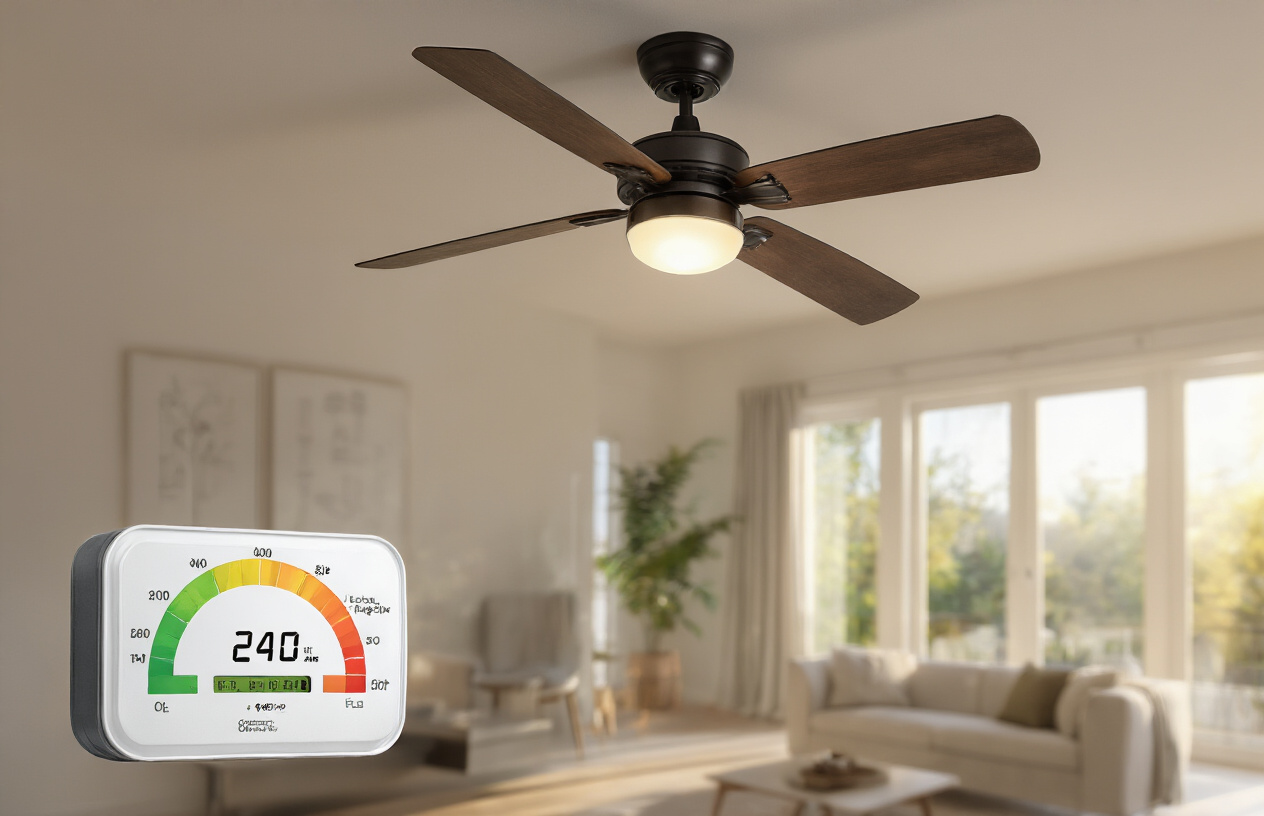
Most people don’t realize this, but ceiling fans don’t actually cool rooms—they cool people. They generate a wind-chill effect that gives the sensation of coolness without altering the room temperature. This simple distinction is why they’re energy-saving champions.
A standard air conditioning unit consumes 3,500 watts during operation, whereas a ceiling fan? Just 15-90 watts depending on speed. That’s up to 90% less energy! Running your fan instead of cranking up the AC can slash your cooling costs dramatically.
The magic happens when you use both strategically. With a ceiling fan running, you can bump your thermostat up by 4°F without feeling any difference in comfort. Each degree raises your thermostat saves about 4-8% on cooling costs.
Key efficiency metrics to consider
When shopping for energy-efficient ceiling fans, these numbers matter:
- CFM/Watt: This measures airflow efficiency—how much air movement you get per watt of electricity. Higher is better.
- Motor Type: DC motors use up to 70% less energy than traditional AC motors.
- Blade Design: Aerodynamic blades move more air with less energy.
A high-quality ceiling fan ought to provide a minimum of 75 CFM per watt. The best models exceed 100 CFM/watt.
Energy Star ratings explained
A high-quality ceiling fan ought to provide a minimum of 75 CFM per watt.. For ceiling fans, it means:
- At least 20% more efficient than standard models
- Performance tested by third parties
- Required to move air at least 5,000 CFM on high speed
- Must come with a minimum 3-year warranty
Energy Star rated fans deliver more airflow per watt while meeting strict quality standards. They’re tested across multiple speeds, not just at their most efficient setting.
Long-term cost savings potential
The upfront price difference between standard and energy-efficient fans might make you hesitate, but do the math:
| Fan Type | Initial Cost | Annual Energy Cost | 10-Year Total |
|---|---|---|---|
| Standard | $100 | $30 | $400 |
| Energy-Efficient | $150 | $10 | $250 |
An energy-efficient ceiling fan pays for itself within 3-5 years for most households. Plus, quality fans last 15+ years, which means a decade of pure savings after the payback period.
During peak summer months, switching from AC to fans could save you $30-50 monthly. Multiply that by years of ownership, and we’re talking thousands of dollars staying in your pocket.
Top Energy-Saving Ceiling Fans for Home
Best budget-friendly options
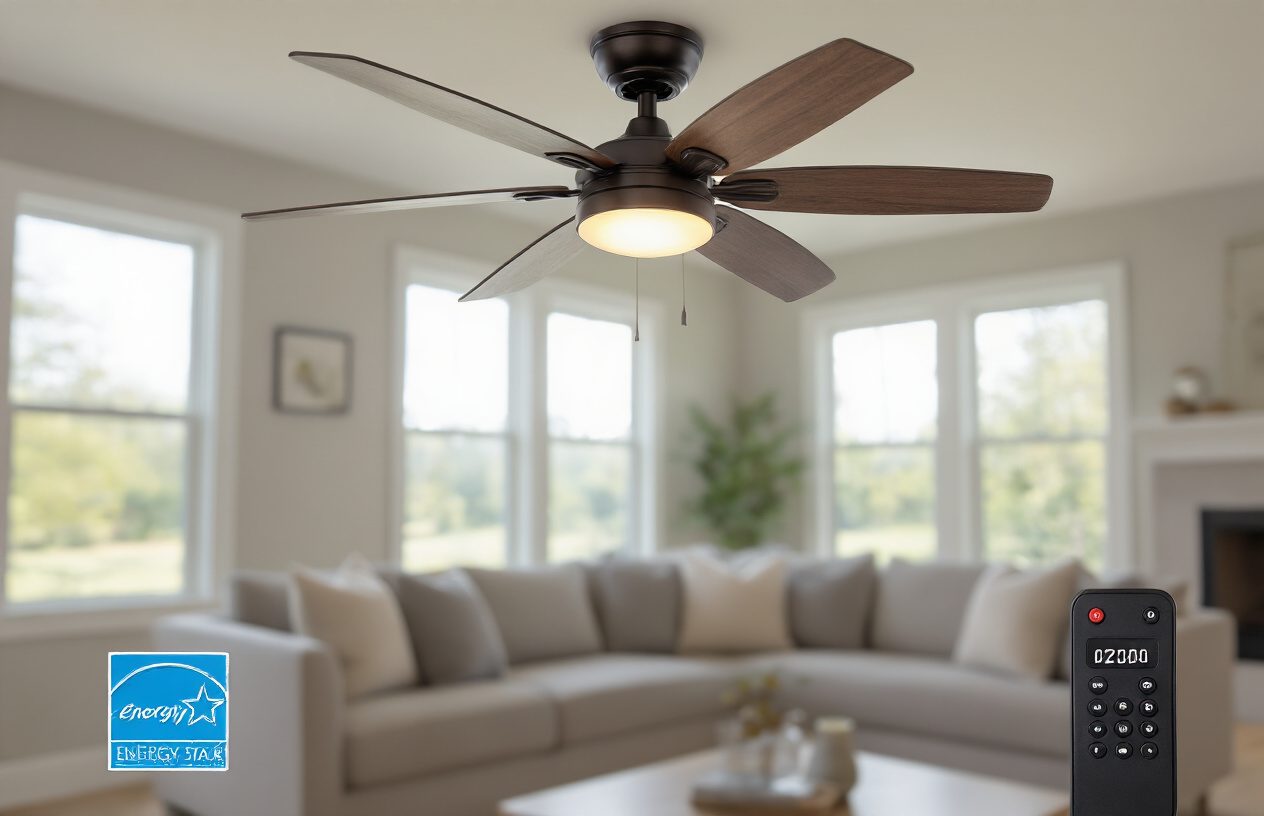
Not everyone has hundreds to drop on a ceiling fan, but that doesn’t mean you can’t slash your energy bills. The Honeywell Carmel 48-inch fan hits the sweet spot at under $100. It uses just 55 watts on high speed while pushing serious air with its five blades.
Want something even cheaper? The Harbor Breeze Armitage 42-inch fan costs around $70 and still cuts your cooling costs by up to 30% compared to AC-only cooling. Its Energy Star certification means it exceeds efficiency standards by at least 20%.
But my personal favorite budget pick is the Westinghouse Comet 52-inch. At a price of $89, it provides exceptional airflow while consuming only 60 watts, accompanied by a lifetime motor warranty. This is a prime example of receiving excellent value for your investment.
Premium models with advanced features
Prepared to invest in the best of the best? The Big Ass Fans Haiku L costs a pretty penny (around $550), but consumes a mere 20 watts while moving more air than fans twice its size. The brushless motor technology is what makes the difference—it’s the same tech used in electric vehicles.
The Minka-Aire Light Wave comes in at $399 and combines stunning minimalist design with whopping 75% energy savings compared to standard fans. The DC motor is the real hero here.
Monte Carlo’s Maverick fan ($349) is another standout. It runs on just 28 watts even at top speed, which is literally a fraction of what traditional AC motor fans use.
Smart ceiling fans with automation capabilities
Smart fans take energy efficiency to a whole new level. The Hunter Signal connects to both Alexa and Google Home and automatically adjusts speed based on the room temperature. It even tracks your energy usage through its app.
The Bond Hub ($99) is a game-changer if you already have ceiling fans. This little device lets you control any remote-operated ceiling fan with your phone or voice commands. Set schedules for different times of day, and you’ll never waste electricity running fans in empty rooms again.
Modern Forms fans offer the most comprehensive smart experience. Their Morpheus model links with smart thermostats to coordinate cooling efforts. When your AC kicks on, the fan automatically speeds up to help distribute cool air faster, then slows once temperature targets are reached.
Stylish designs that don’t sacrifice efficiency
Who says efficient can’t be gorgeous? The Matthews Irene 3-blade fan looks like something from a high-end design magazine but uses a DC motor that’s 70% more efficient than standard options.
Hunter’s Cavera fan rocks a farmhouse-industrial vibe that’s super trendy but still cuts power usage by 40% compared to AC motor fans.
For mid-century modern lovers, the Monte Carlo Clarity is a showstopper that draws just 31 watts on high. Its transparent blades create the illusion that there’s nothing there while still cooling effectively.
Best for large living spaces
Big rooms need powerful but efficient solutions. The Emerson Aira Eco delivers massive airflow using just 33 watts thanks to its DC motor technology. It can effectively cool spaces up to 400 square feet.
The Fanimation Odyn spans a whopping 84 inches but somehow uses less electricity than most 52-inch models. This beast moves over 11,000 cubic feet of air per minute on high speed while drawing just 31 watts.
For open-concept spaces, consider the Hunter Advocate. With a 60-inch blade span and specially designed airfoils, it creates consistent airflow throughout large areas without cold spots or hot spots. It’s Energy Star rated despite its impressive size and power.
Office-Optimized Energy-Efficient Fans
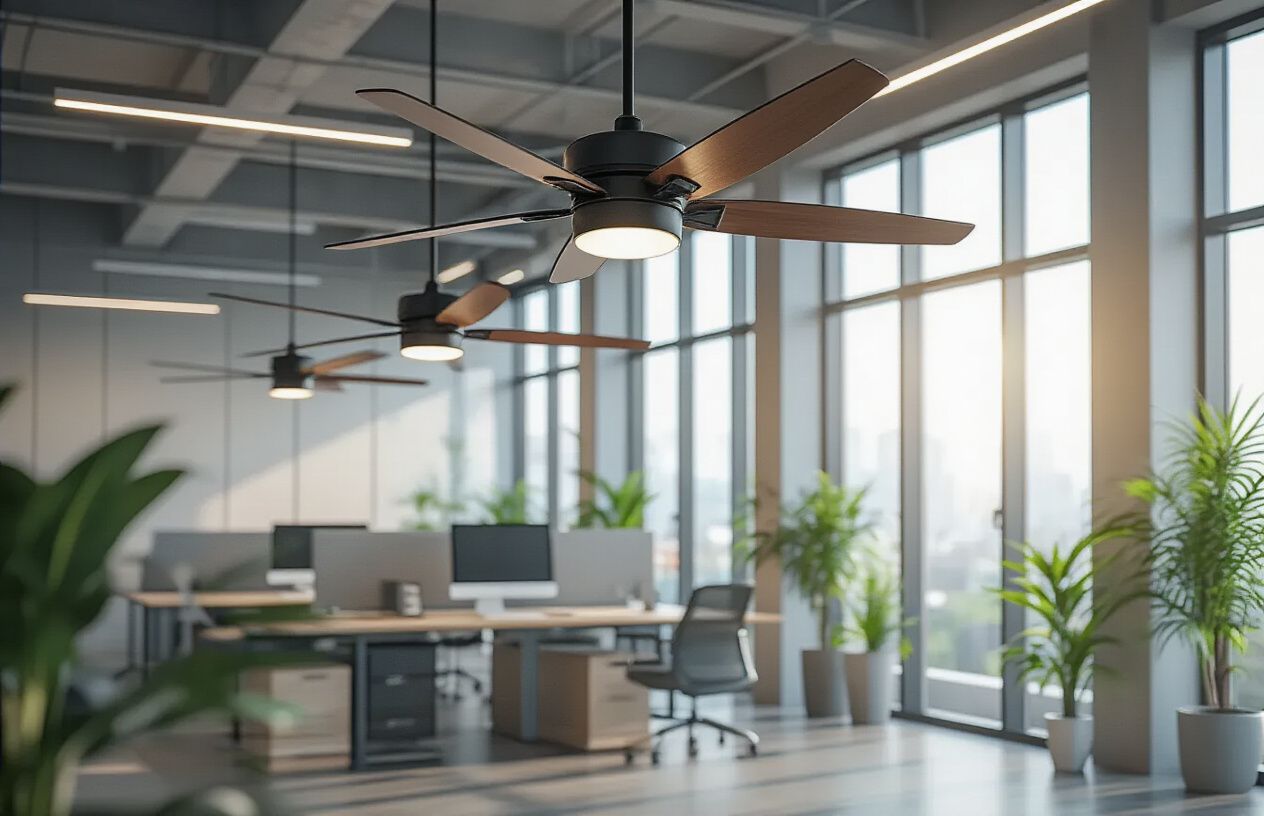
Commercial-grade energy savers
Office buildings eat up electricity like nobody’s business. That’s why commercial-grade energy-saving ceiling fans are game-changers for businesses watching their bottom line.
These fans aren’t your average home models. They’re built with heavy-duty motors and premium materials that handle non-stop operation. Most come with DC motors that use up to 70% less energy than traditional AC motors while maintaining powerful airflow.
Top picks include the Big Ass Fans Haiku L and the Emerson Eco.
These powerhouses move massive amounts of air while sipping electricity. They pay for themselves within 2-3 years through reduced HVAC costs.
What separates these from residential models? Smart building integration capabilities. Many connect directly to your building management system, automatically adjusting based on occupancy and temperature data.
Noise-reducing models for productive environments
Nothing kills focus like the constant drone of a noisy fan. The latest noise-reducing models operate at whisper-quiet levels under 35dB.
The Hunter Signal operates so silently your employees won’t even notice it’s running. The Matthews IC/Air3 is equipped with uniquely crafted blades that slice through the air without producing the unpleasant whooshing sound that many of us have come to dislike.
The key lies in the design and balance of the blades. High-end models are subjected to rigorous vibration testing to eradicate wobble, which is the primary cause of bothersome fan noise.
Fans with adjustable speeds for varied office conditions
Office environments change throughout the day. Morning chill, afternoon heat, varying occupancy levels—one speed doesn’t cut it.
The best office fans offer at least 6 speed settings, with premium models featuring infinite speed adjustment. The Modern Forms Aviator provides 6 speeds plus a “Breeze” mode that randomly varies speeds to simulate natural airflow.
Smart models like the Minka-Aire Xtreme H2O connect to temperature sensors, automatically adjusting speeds as conditions change. This set-it-and-forget-it approach ensures comfort while maximizing energy savings.
Look for fans with remote access capability—letting facility managers control multiple units from a central dashboard. This prevents the energy waste that happens when fans run in empty rooms or at inappropriate speeds.
Installation Considerations for Maximum Efficiency
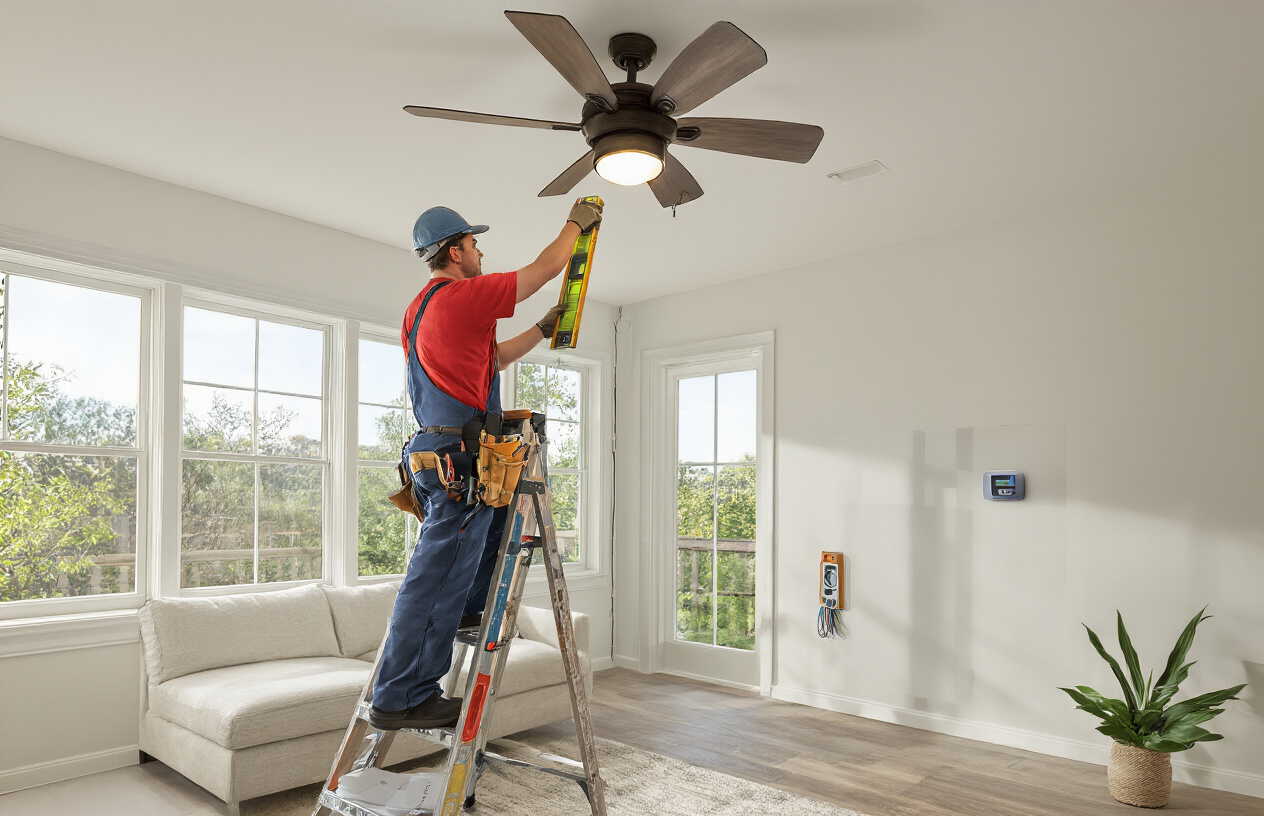
A. Optimal ceiling height and room placement
Ever installed a ceiling fan only to find it’s too low and might decapitate your taller friends? Yeah, not fun.
To achieve optimal efficiency, it is essential to have a minimum height of 8 feet from the floor to the ceiling, with the fan positioned 7 to 9 feet above the floor. Got higher ceilings? Use a downrod to get that perfect height.
The sweet spot for placement is dead center of the room. This guarantees uniform air distribution across the entire area. For larger rooms, multiple fans work better than one giant spinner.
And please, don’t mount your fan directly above beds or workstations unless you enjoy papers flying everywhere or weird sleep-inducing air patterns.
B. Proper sizing guidelines
Size matters when it comes to ceiling fans. Too small and it’s basically just decorative. Too large and your room feels like a wind tunnel.
Here’s the quick breakdown:
| Room Size | Fan Size |
|---|---|
| Up to 75 sq ft | 29-36 inches |
| 76-144 sq ft | 36-42 inches |
| 145-225 sq ft | 44-50 inches |
| 225-400 sq ft | 50-60 inches |
Kitchens can go smaller (30-36 inches), while large open spaces might need multiple fans or those massive 60+ inch models.
C. Seasonal rotation settings
Your ceiling fan has two rotation settings for a reason, and most people get this wrong.
Summer: Set to counterclockwise. This action forces air downward, resulting in a cooling breeze effect. You’ll actually feel cooler even with your AC set higher, saving you cash.
Winter: Switch to clockwise at a low speed. This pulls cool air up and pushes warm air that’s collected near the ceiling back down the walls and into the room. Genius, right?
The difference in your energy bills can be up to 15% just by flipping that little switch with the seasons.
Smart Features That Enhance Energy Savings
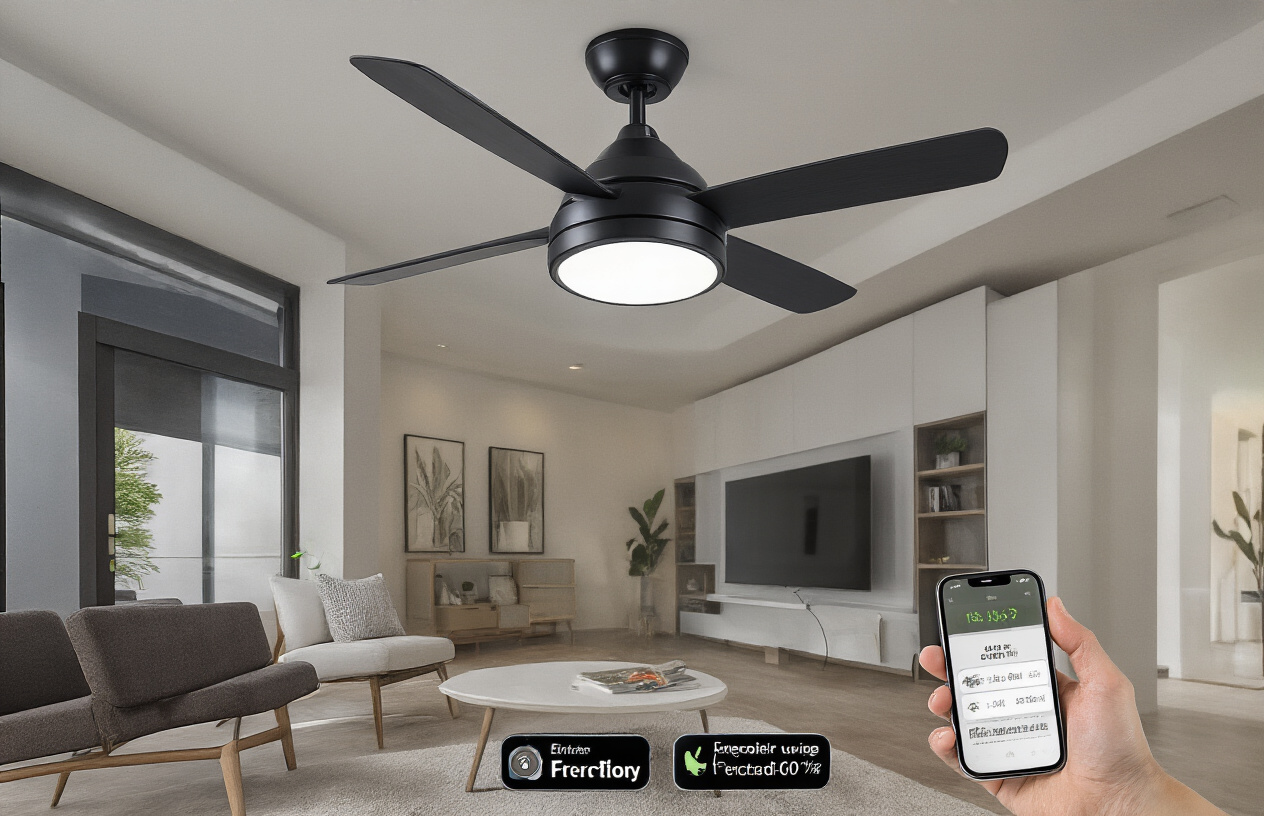
Remote control and smartphone integration
The era of tugging on chains and ascending ladders is now behind us. Today’s energy-efficient ceiling fans come with remote controls that let you adjust speed, lighting, and direction from your couch. But the real game-changer? Smartphone integration.
Many high-end models now connect to your home WiFi, allowing you to control your fan from anywhere using an app. Forgot to turn off the fan before leaving for work? No problem. Just grab your phone and tap the app.
Some fans even work with voice assistants like Alexa and Google Home. Just say, “Hey Google, set the fan to medium speed,” and it’s done. This convenience doesn’t just save effort—it saves energy by making it dead simple to adjust settings based on your needs.
Motion sensors and occupancy detection
Smart fans with motion sensors are like having a personal assistant who knows exactly when you need cooling. Walk into a room, and the fan turns on. Leave for a while, and it automatically shuts off.
This automatic operation eliminates those “oops” moments when fans run in empty rooms for hours. Most models let you set the delay time before shutoff, so you won’t get caught in sudden stillness if you’re just sitting still reading a book.
Temperature monitoring capabilities
The smartest ceiling fans today come with built-in temperature sensors that make automatic adjustments based on room conditions.
When the room heats up, these intelligent devices increase speed to improve cooling. When temperatures drop, they slow down or switch off completely. Some models even reverse direction automatically in winter to push warm air downward without you lifting a finger.
Scheduling and automation benefits
Creating a fan schedule based on your routine is where significant energy savings happen. Program your fan to run at higher speeds during peak afternoon heat and lower speeds in the evening.
Many smart fans also integrate with your home’s smart thermostat, working together to optimize cooling efficiency. This coordination can raise your AC temperature setpoint by 4-7 degrees while maintaining comfort, slashing your cooling costs dramatically.
Some advanced models even learn your preferences over time, automatically adjusting to your habits without manual programming.
Maintenance Tips to Preserve Efficiency
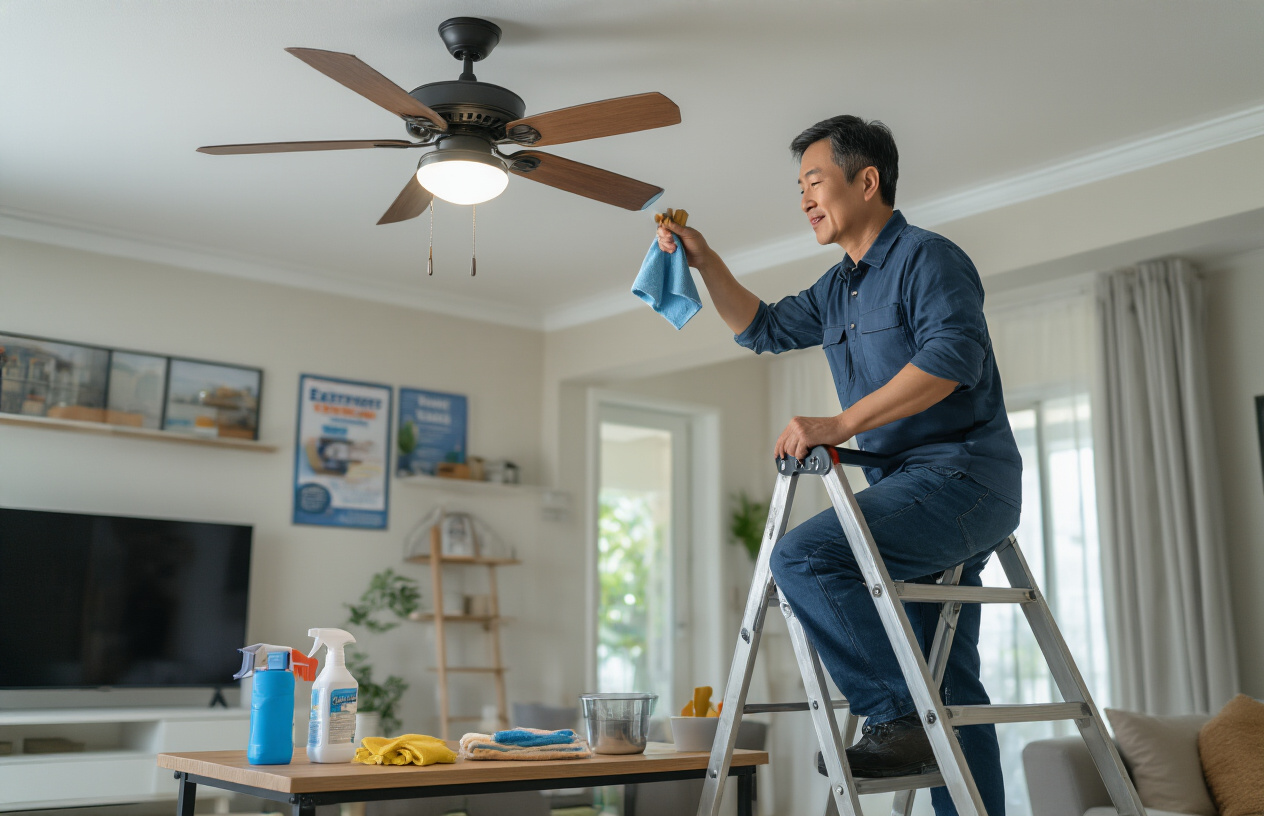
Regular cleaning protocols
Your fancy energy-saving ceiling fan won’t stay efficient if it’s covered in dust. Believe me, I acquired this knowledge through difficult experiences.
Dust buildup is like putting a winter coat on your fan – it makes the motor work harder and uses more electricity. Here’s what works:
- Every two weeks, wipe down the blades with a microfiber cloth
- For a more thorough cleaning every three months, employ the pillowcase method: place a pillowcase over each blade, then press and pull to capture dust within
- Don’t forget the motor housing! A gentle brush can remove dust without damaging components
Expert advice: ensure the fan is turned off and has come to a complete stop prior to commencing the cleaning process. Your fingers will thank you.
Balancing techniques for optimal performance
Ever notice that wobble? An unbalanced fan is not only bothersome, but it is also inefficient and poses safety risks.
Grab a balancing kit from any hardware store (they’re cheap) and follow these steps:
- Mark each blade with tape or sticky notes (1,2,3,4,5)
- Run the fan on medium speed to identify the wobble
- Attach the clip to the middle of each blade, one at a time
- The blade that reduces wobble when weighted is your culprit
- An unbalanced fan is not only bothersome, but it is also inefficient and poses safety risks
- Once balanced, attach the permanent weight
Sometimes the fix is even simpler – just tighten all screws and make sure blades are properly aligned.
When to replace versus repair
Ceiling fans aren’t forever, but replacing them too soon wastes money and resources.
Signs it’s repair time:
- Wobbling (even after balancing)
- Unusual noises
- Slowing speeds
- Minor light fixture issues
Signs you need a new fan:
- Motor runs hot
- Frequent stopping
- Burning smell
- Fan is 10+ years old with multiple issues
- Repair costs exceed 50% of replacement
Remember that newer models are typically 60% more efficient than fans made just 10 years ago. Sometimes replacement is the more energy-conscious choice in the long run.
Cost-Benefit Analysis of Energy-Efficient Fans
A. Initial investment versus long-term savings
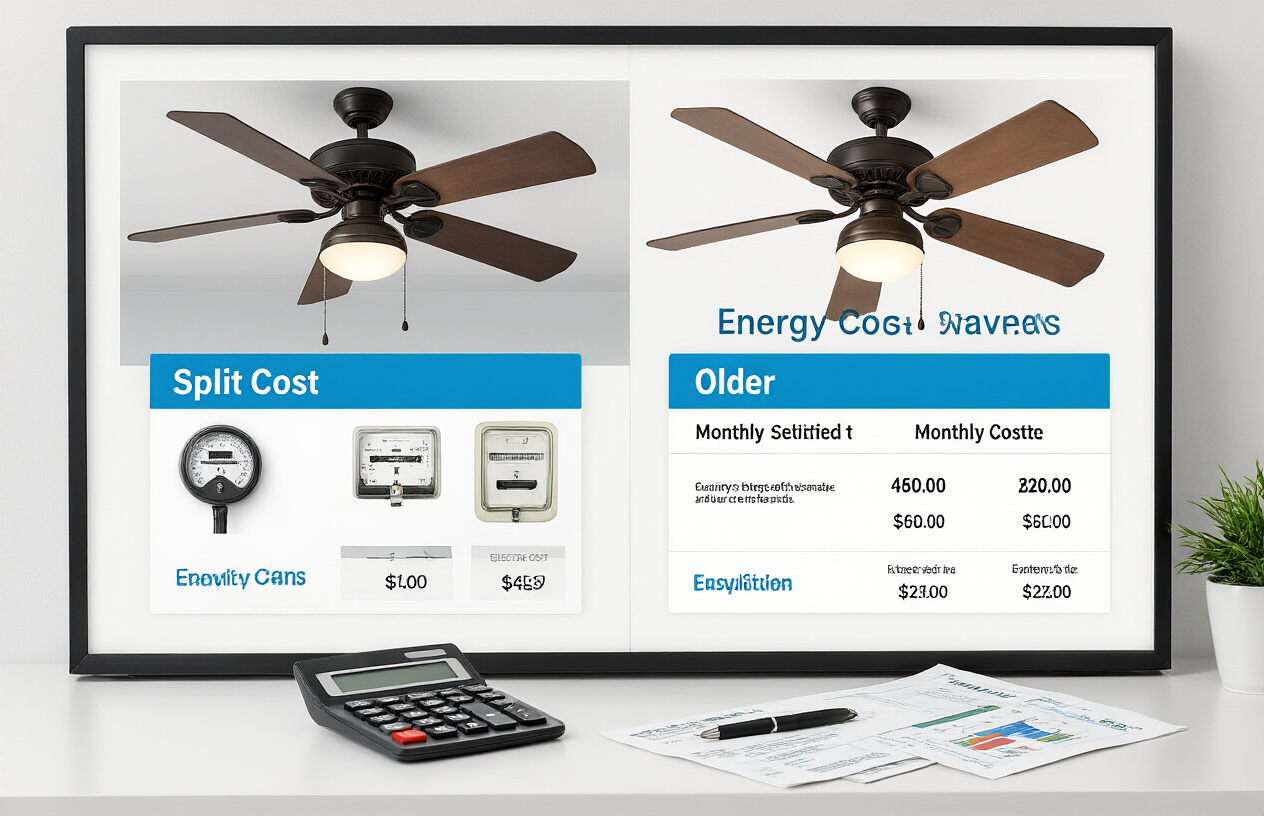
Thinking about dropping $300+ on a ceiling fan when you can grab a basic model for $100? I totally get it. But here’s the deal—energy-efficient fans pay for themselves faster than you might think.
The math is pretty simple. A standard ceiling fan uses about 75 watts, while an ENERGY STAR model might use just 35 watts. Running your fan 8 hours daily, that’s a difference of 40 watts or roughly 116 kWh annually. At the average electricity rate of $0.14/kWh, you’re saving about $16 per year.
Not impressed? Consider this: premium energy-efficient fans also last 2-3 times longer than budget models. No more replacing fans every few years!
B. Rebates and incentives available
Nobody likes leaving money on the table. Many utility companies offer rebates ranging from $15-50 when you purchase ENERGY STAR ceiling fans.
Some states have additional incentives through energy efficiency programs. California, for example, offers rebates up to $75 for qualifying models through their Energy Upgrade California program.
The federal tax credit for home improvements that enhance energy efficiency occasionally encompasses ceiling fans as well. Check the Database of State Incentives for Renewables & Efficiency (DSIRE) website for current offers in your area.
C. Comparing fan efficiency to traditional cooling methods
Air conditioning burns through electricity like nobody’s business. Let’s look at the numbers:
| Cooling Method | Average Hourly Energy Use | Monthly Cost (8hrs/day) |
|---|---|---|
| Central AC | 3,500 watts | $117.60 |
| Window AC | 900 watts | $30.24 |
| Energy-Efficient Fan | 35 watts | $1.18 |
Using ceiling fans alongside AC allows you to raise your thermostat by about 4°F without sacrificing comfort, cutting cooling costs by up to 30%.
D. Return on investment timeline
The premium you pay for an energy-efficient fan typically ranges from $50-200 above standard models. Taking annual energy savings ($16), potential rebates ($25-50), and longer lifespan (7+ years vs. 3-5 years), most homeowners break even within 2-3 years.
The real magic happens after the breakeven point. Over a 10-year period, an efficient fan can save you $350-500 in energy costs and replacement expenses. That’s enough to buy your next fan with money left over!
Selecting an appropriate energy-efficient ceiling fan represents a wise investment for both residential and commercial settings. From understanding the key efficiency metrics to exploring smart features that maximize energy savings, these seven top-rated models offer the perfect balance of performance, style, and sustainability. Regular maintenance and proper installation further enhance their efficiency, ensuring you enjoy cool comfort with minimal environmental impact.
As energy costs continue to rise, the initial investment in a quality energy-efficient fan quickly pays for itself through reduced utility bills. Whether you’re looking to outfit your living room, bedroom, or workspace, these eco-friendly options provide an effective cooling solution while reducing your carbon footprint. Select the model that best suits your specific needs, and enjoy the perfect combination of comfort, savings, and environmental responsibility for years to come.
7 Best Energy-Saving Ceiling Fans for Home and Office By:
By: